What can NDIS in-home support include in Brisbane?
A practical guide for Brisbane, Banyo and North Brisbane participants comparing NDIS in-home support, personal care, daily routines and community access.
Quick answer
NDIS in-home support in Brisbane can include help with personal care, daily routines, meals, household tasks, skill building and community access when those supports match the participant's NDIS plan, goals and disability-related needs. For Tibii's current SEO service-area focus, this article is written for Brisbane, Banyo and North Brisbane participants comparing practical daily support at home.
The most useful way to think about in-home support is not as a generic home-care package. It is a set of supports that should help the participant live more safely and independently, use their plan correctly, and keep choice and control over their routine. If you are comparing providers now, start with Tibii's Brisbane in-home disability support page and the main in-home disability support service page.
What official NDIS guidance says
The NDIS explains that NDIS supports are services, items and equipment that can help participants complete daily living activities, build independence and skills, and work toward their goals. That matters because in-home support should be tied back to the goals and support categories in the person's plan, not just to a list of chores.
For home and living, the NDIS describes Assistance with Daily Life as help with everyday tasks in the home, including cooking, cleaning and personal care support. The same NDIS guidance also makes an important boundary clear: participants usually remain responsible for ordinary day-to-day living costs such as rent, groceries, utilities, phone and internet. In other words, the NDIS may fund disability-related support to do a task, but that does not automatically mean it pays every household cost connected to the task.
The NDIS support budgets guidance is also relevant. It lists support categories such as assistance with daily life and assistance with social and community participation, and explains that some funding is flexible while other funding is stated. A participant, nominee or support coordinator should check the actual plan before booking ongoing supports, especially if support will combine personal care, household tasks and community access.
What in-home support can include
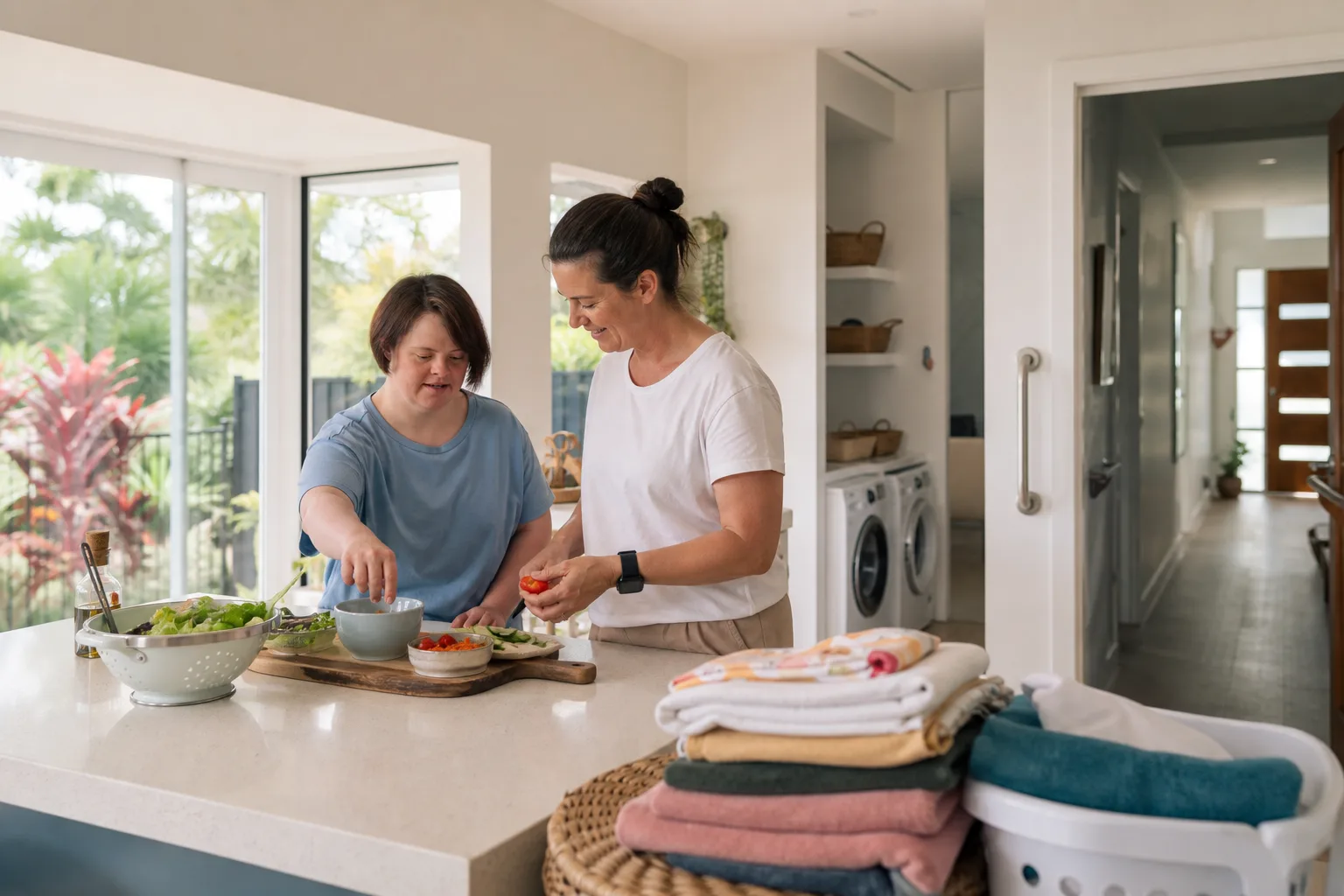
In-home support often starts with the routines that make the day work. That might mean help getting ready in the morning, preparing for appointments, keeping the home safe and usable, or practising tasks that build independence over time.
- Personal care: support with hygiene, showering, dressing, grooming, toileting, eating and drinking, or moving safely around the home where this is part of the person's disability-related support needs.
- Meal routines: prompting, preparation support, cooking alongside the participant, cleaning up, or building confidence with regular meals.
- Household tasks: support with cleaning, laundry, dishes, tidying and simple home routines where the need is related to disability support.
- Skill building: practising daily living tasks with the right level of prompting, supervision or hands-on support so the person can build confidence rather than have every task taken over.
- Community access from home: support to leave home for appointments, shopping, social activities or local community participation when that fits the plan and goals. Tibii also has a dedicated community access support page.
The NDIS Quality and Safeguards Commission's personal care guidance is a useful safety lens. It describes personal care as support for someone who cannot do those activities independently, with examples including hygiene, toileting, eating and drinking, and positioning or moving. Those tasks require trust, privacy and clear worker expectations.
How to match support to the person's routine
A strong in-home support arrangement should feel specific. Before a provider starts, the participant and support network should be able to explain what happens on a normal weekday, what changes on weekends, which tasks are private or sensitive, and where the person wants more independence. The provider should also understand communication preferences, cultural needs, household rules, pets, access instructions, medication prompts if relevant, and when family members or other supports are usually present.
For Brisbane participants, the practical questions are often local and routine-based. Does the participant need short morning shifts before work or day programs? Is support needed after school, after appointments, or around public transport? Are the main goals personal care, household confidence, community access, or a mix? If coordination is complex, Tibii's support coordination service may also be relevant where the participant has support coordination funding.
Provider questions before you start
When comparing in-home support providers, ask questions that reveal how the service will actually work in the home.
- Which tasks will be supported, prompted, supervised or left for the participant to do independently?
- How will the worker learn the participant's preferences, communication style and privacy boundaries?
- What happens if a regular worker is unavailable?
- How are risks reviewed, especially if one worker supports a participant who lives alone?
- How will the provider monitor whether the support is helping the participant build independence?
- How are cancellations, travel, shift notes and service agreement terms handled?
The NDIS Commission notes that registered personal support providers delivering assistance with daily personal activities to participants who live alone have extra registration conditions, including risk assessment and quality monitoring. The Commission's Code of Conduct also says participants have the right to safe and ethical supports. Those safeguards are not just compliance wording; they are practical prompts for what a provider should be able to explain clearly.
What in-home support should not promise
Be careful with any provider or article that promises a fixed funding outcome. Tibii does not decide whether the NDIS will fund a support, whether a plan will be increased, or whether every requested task is claimable. The safe position is to check the plan, goals, funding category and NDIS rules, and ask a my NDIS contact, plan manager or support coordinator when something is unclear.
It is also worth separating disability support from ordinary household costs. Support workers may help with cooking or cleaning when that support is disability-related and funded in the plan, but groceries, rent, utilities and general household items are usually the participant's own living costs. This distinction helps avoid budget surprises later.
Local next steps in Brisbane, Banyo and North Brisbane
If you are looking for in-home disability support in Brisbane, write down the three routines that need the most support first. For many people, that will be morning personal care, meal routines, laundry or cleaning, and getting out to appointments or community activities. Then check the plan and talk with the provider about what can be delivered, how often, and how the support will be reviewed.
Tibii is a registered NDIS provider with a current SEO focus on Brisbane, Banyo and North Brisbane. You can compare the broader Brisbane NDIS provider page, review the in-home support pages above, or contact Tibii to discuss whether the service is a suitable fit for the participant's goals and support needs.
FAQs
Is in-home support the same as SIL?
No. In-home support can help with targeted daily tasks in the person's own home. Supported Independent Living is generally for people who need a higher level of support at home, often across the day and week. The right pathway depends on the person's plan and support needs.
Can NDIS in-home support include cleaning?
It can include assistance with household tasks such as cleaning or laundry when the need is related to disability support and the plan allows it. It should not be treated as a general domestic cleaning service unrelated to the participant's disability needs.
Can personal care be included?
Yes, personal care may be included where it is part of the participant's funded supports. This can involve support with showering, dressing, grooming, toileting, eating, drinking or safe movement, delivered respectfully and with attention to privacy.
Who should enquire for a Brisbane participant?
The participant can enquire directly, or a family member, nominee, guardian or support coordinator can help make contact. The provider will still need enough information about the participant's goals, preferences, plan and consent arrangements before support starts.
Back to Tibii Blog | Contact Tibii — 1300 736 731